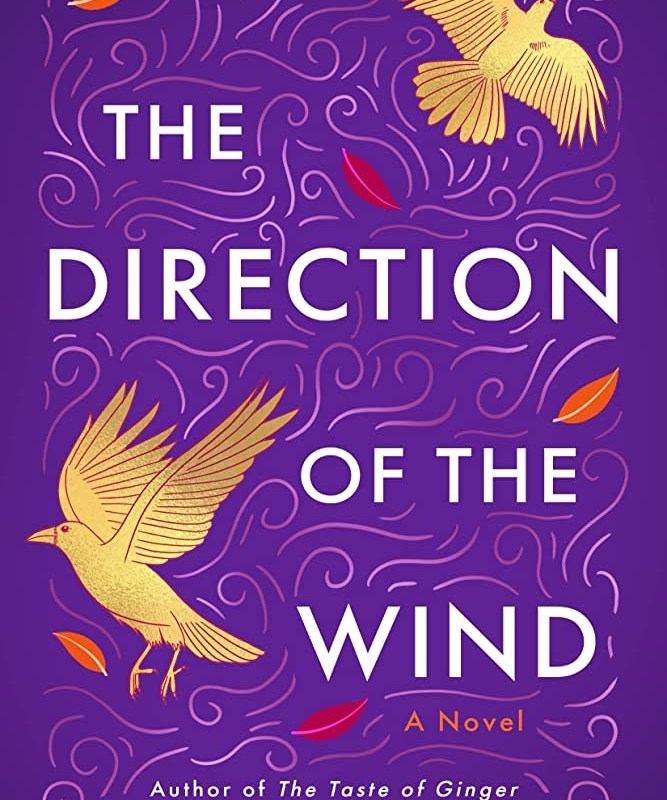
TSM Book Club Book #22: The Direction of the Wind by Mansi Shah

Started: May 22nd
Finished: June 2nd
TSM Rating: 4/5

It is only by pure coincidence that the last two books I picked up to the end of May featured protagonists struggling with mental health issues with varying degrees of severity. Both deal with heavy topics of suicide, depression, loss, drug abuse, and parental abandonment.

Direction of the Wind tells the story of Nita and Sophie Shah, a mother and daughter told twenty years apart. They both grew up in similar circumstances but with drastically different experiences.

The story opens with Sophie mourning the death of her beloved father. Losing him brings her back to her mother’s death as a child. When she overhears her aunts speaking of her mother leaving, not dying, it sets Sophie on a journey that is equal parts heartbreaking and hopeful.

Twenty years before Sophie’s journey, Nita takes one of her own. Overwhelmed by her community’s expectations of her as a wife and mother and driven by a growing desire to be an artist, she packs up as much as she can and leaves her marital home, and boards a plane to France.

While Mansi Shah doesn’t label what precisely is wrong with Nita, she is clearly suffering from depression and has been for most of her life. It seems that being forced into marriage and motherhood only exacerbates her condition, weighing her down in a way that feels inescapable.

After a while, though, she begins to feel the same trapped feeling in France as in India. Trapped by circumstance. Trapped by things beyond her control, and she can’t figure a way out.

She had felt trapped in her life in India, but now she was learning a new form of being trapped and wondered if people were always trapped by something, no matter what they did or where they were.

Direction of the Wind, page 88

As with Recipe for Persuasion, another woman struggles with motherhood, what it means to be a mother, and how to do what is best for her child. For Nita, it was leaving because she felt herself beginning to resent Sophie. She left to save her daughter from her “darkness,” as she put it.

They were the most serious thing that could happen in one’s life. Children highlighted every trait you lacked. And if you were not meant to be a parent, they stole your spirit in a way you could never get back.

Direction of the Wind, page 136

While it’s a story of family, it’s also a story about friends who become family to both Nita and Sophie. They both have strangers come into their lives when they need them the most. For Nita, it’s Dao. For Sophie, it’s Manoj and Naresh.

The words “I’m here for you” had a power in them that was greater than any other, even the phrase “I love you.” “I’m here for you” showed solidarity and acceptance and conveyed in the best way possible that one was not alone.

Direction of the Wind, page 222

Family is complicated. Expectations are complicated. Secrets are complicated. Mansi Shah weaves Sophie and Nita’s sorties together so well; each chapter picks up where the other left off, as Sophie follows right behind her mother, missing her by just a few steps rather than two decades. While the story has dark moments, there is always hope just around the corner.
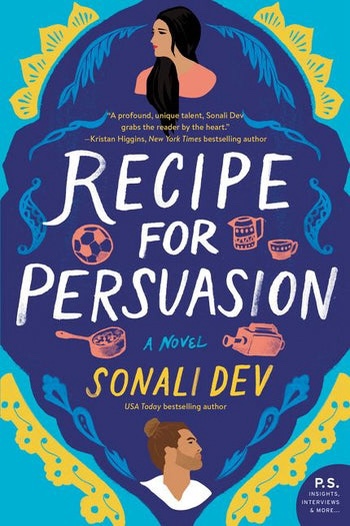
TSM Book Club Book #21: Recipe for Persuasion by Sonali Dev

Started: May 22nd
Finished: May 31st
TSM Rating: 4.5/5

It is only by pure coincidence that the last two books I picked up to the end of May featured protagonists struggling with mental health issues with varying degrees of severity. Both deal with heavy topics of suicide, depression, loss, drug abuse, and parental abandonment.

First up is Recipe for Persuasion, whose lead, Ashna Raje, spends her whole life doing what she can to make her father happy much to her own detriment. She also spends most of her life angry with her mother for abandoning her time after time.

On the brink of losing her restaurant, typically reserved Ashna, through some coaxing by her best friend and cousin, ends up a chef competing on a celebrity cooking show in order to win the money to save it. The show’s premise is to pair a professional chef with a celebrity, and much to her surprise, Ashna is paired with her high school sweetheart turned professional soccer player Rico Silva. For his part, Rico has his own struggles as he never really got over Ashna and the abrupt ending to their relationship. When we meet him, he has reached the point where he has to confront his past in order to move forward.

On top of all this, Ashna’s whirly-gig of a mother, Shobi has chosen this moment in Ashna’s life to come back and try to fix things with her. Ashna has spent her life building walls to protect herself from her mother bouncing in and out of her life. To protect herself from her parents’ fighting. Even when her father commits suicide, she builds walls around herself to keep herself protected from disappointment and disappointing.

Throughout the book, we see her struggle to maintain control over her life and struggle as she tries to be a stronger version of herself. She needs to be that version of herself as she confronts the past with Shobi and Rico.

Recipe… epitomizes the phrase, “Sometimes you have to go back to move forward.”

I loved it for how it examined mother-daughter relationships and even what it means to be a mother. Shobi’s struggle to find work-life balance and to reconcile her own feelings about being a mother and wife and what she was forced to give up to reclaim her independence.

This was the problem with motherhood, the part Shobhan didn’t understand — why did it have to be an all-or-nothing game? Weren’t mothers human?

Recipe for Persuasion, pg. 269-270

I also loved the depth of love Ashna and Rico have for each other, even after twelve years apart. Love, real love, can stand the test of time and distance. The word Dev uses over and over to describe how Ashna and Rico feel about each other is essential. I loved how perfectly and succinctly it sums up what they are to each other.

Sometimes when people leave you, you get so caught up in trying to convince yourself that you can cut them out of your life that you think you’ve actually figured it out. You keep moving. You ignore the feeling of being chased, even as you can’t stop running and running to get away. But then you realize that you haven’t moved on at all. Those who are essential to you have always been an absence. Even when you refused to acknowledge it, their void was always there.

Rico, Recipe for Persuasion, page 344

This was such a good read. Even with some of the darker themes, there was a lot of hope and love infused into the story. It should be noted that this is the second book in a series. I didn’t realize it until I started this one, but the stories are stand-alone. I’ve already added Pride, Prejudice, and Other Flavors (the books are Sonali Dev’s reimagining of Jane Austen classics).

TSM Book Club Book #20: The Ones We Fight For by Katie Golightly

Started: May 6th
Finished: May 21st
TSM Rating 4/5

This was my first time reading a book on Kindle. I have mixed feelings. On the one hand, it’s convenient to have a book at the tip of my fingers and the highlighting on demands clutch. On the other hand, it’s more time on my phone, and the page numbering is a little weird.

That being said, I really enjoyed this book. It was a slow-burn, friends-to-lovers story about two imperfect people — Walker Hartrick and Talia Cohen — doing their best to survive after their worlds are flipped upside down. Walker has just lost his brother and sister-in-law in a drunk driving accident. This leaves him as the guardian of his five nieces and nephews.

For Talia, she is dealing with the one-two punch of finding out that she is infertile and her engagement ending. On top of that, her estranged father was responsible for Walker’s loss.

The beauty of this story is how believable and relatable both their journeys are. In some ways, Walker is the poster child of toxic masculinity’s belief that seeking help is a sign of weakness and the only way he can be any good to his family is to be “strong.” Even as his body is physically breaking down with panic attacks, he continues pushing to be there for his family.

In her own way, Talia is white-knuckling life as well. She comes to town to take over her father’s grocery store and throws herself into work. She also leans into being good to everyone else, including Walker and his family. Leaning into it helped her rediscover her self-worth and slowly heal from all that was ailing her.

When Talia and Walker come together, magic happens. They learn from each other. Give each other support and lift each other up. They help each other through, and both come out stronger on the other side.

I like that Golightly takes her time with the story and doesn’t rush through their progression, notably Walker’s. There are a lot of conclusions that he has to come to on his own. He wasn’t going to take specific steps until he was ready.

This book is filled with lots of little nuggets of wisdom. My favorite is this one:

Her mother always said “time is the wisest counselor of all.”

The Ones We Fight For, Chapter 23, page 198 (Kindle)

It’s a nice story, but be warned, it covers many heavy topics, including death, alcoholism, and infertility, all of which can be triggering for some.

TSM Book Club Book #19: The Verifiers by Jane Pek

Started: May 2nd
Finished: May 13th
TSM Rating: 3/5

The Verifiers was an interesting read. It’s a niche organization that specializes in tracking online dating matches. It follows the story of Claudia Lin, who works for a mysterious agency of private investigators on steroids.

The story begins with a client, Iris Lettriste, who comes to the agency to discover the truth about a man she has matched with. As Claudia and her colleagues, Komla and Becks, look into this mystery man, Irs shows up dead. Thus begins Claudia’s spiral into a world of mystery and intrigue like the detective novels that she loves so much.

At the core of this story is human connection and relations. How do we see ourselves? How do we see each other? Which version of ourselves is true: the version we show the world or the version we keep to ourselves? In all of that, how does this affect our ability to find true love?

Claudia’s interest n working for Veracity is purely for the investigation aspect of the job. She has no interest in finding a relationship for herself, nor does she really foster her relationships with her friends and family. That’s not to say that she doesn’t love them and appreciate their place in her life, but, as is brought up by both her brother and her sister, she takes a lot for granted. Granted, she does some of that because she doesn’t seek the attention given to her, i.e., her mother constantly tries to set her up with a nice Chinese boy (Claudia is a lesbian), and her brother tries to find her a perfect corporate job.

As she goes down the rabbit hole to discover what really happened to Iris Lettriste, Claudia finds that everyone is hiding something, even from the people who are supposed to know us best. Her investigation also raises the question of how far we are willing to go to protect the people that we love and who claim to love us back.

It’s a fun, if not at times frustrating, mystery as Claudia always seems to be behind the proverbial eight ball, even when it seems like she’s figured everything out. My favorite part of the book was the subplot of Claudia looking into her sister, Coraline’s boyfriend, and the discoveries she makes about trust, truth, and how far some are willing to go in their own selfish pursuits of success.